
Dynaudio Contour 20 Black Edition Standmount Speakers
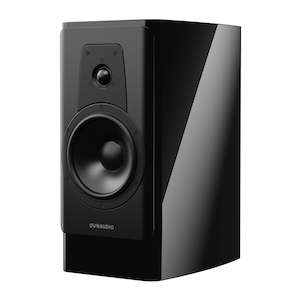
Speaker stands are not included and are sold separately.
Contour 20 Black Edition is the apex of 40 years of Contour.
Every component has been taken and upgraded. Every nuance improved. And every surface made black.
Heights of perfection
Good engineers aren’t happy unless they’re unhappy. Not in an existential way; more that it means they’ve found something they want to improve, and the solution is nagging at them. (Although sometimes, of course, that can definitely skirt the edges of an existential wobble…)
They went through it in 2016 when Contour was revamped into its current look. It happened again in 2020, when the family gained the ‘i’ badge after being perked-up by a raft of trickle-down Confidence tech.
And they went through it once more in the months before the first Contour 20 Black Edition rolled off the production line at the factory in Denmark. During development this time, their unhappiness made them extremely happy, because they got to throw the kitchen sink at it.
Box: clever
Contour already had a brilliant foundation. The cabinet construction is stellar: thick, solid and with a shape that minimises unwanted vibrations and standing waves. And the heavy aluminium baffle (which is actually a lot thicker than it looks) does wonders for increasing stability and eliminating diffraction.
So, how does one improve on the rest? By reaching into the bag of tricks Dynaudio Labs has been filling up since 1977 and plucking out the best bits of the best bits.
High spirits
From the top: high frequencies are handled by the Esotar 3 tweeter. It comes directly from the flagship Confidence range – and is, quite simply, the best tweeter Dynaudio has ever produced. (So far.)
The soft-dome diaphragm is finished with a DSR coating. It’s a high-precision method, formulated and mixed by hand and applied by robots, that puts the coating at the exactly right density in exactly the right places, so the listener hears exactly what they’re supposed to hear. Which is exactly what the artist wants. (And while Dynaudio isn’t allowed to disclose exactly what the DSR coating is, they can share what the acronym stands for: Dynaudio Secret Recipe. So now it's known.)
Stabilising influence
Directly behind the diaphragm sits the Hexis. This ingenious little dimpled dome sits behind the main diaphragm. It can just about be seen in the right light. It might even be called camera-shy. But it performs something extraordinary, back there in the dark.
It helps the tweeter breathe. It helps the music breathe.
The Hexis smooths out the tweeter’s frequency response and reduces unwanted resonances – the kind that colour music – by gently guiding the moving air behind the fabric dome. It channels the flow in exactly the right way in and out of the conduit system in the rear chamber behind the magnet. The movement is minuscule – only fractions of a millimetre – and it happens tens of thousands of times a second.
It means high frequencies are heard with all the emotion intended. The sharp attack of a well-rosined bow on a cello string as the player digs in. The epic, soaring crescendo of the first violins. The cocksure sizzle of the hi-hats as the drummer counts in.
Do it a favour: shine a torch onto the tweeter and give it a nod of thanks.
Air marshal
In the way-back there’s a labyrinth of conduits, shaped vents and more. There’s a large rear chamber to reduce resonance, improved damping, and the super-strong neodymium magnet and lightweight aluminium voice-coil complete the all-star team.
Esotar 3 is more sensitive than previous models, which means it can react with a lower input voltage, which means it doesn’t get hot as fast. And that means it can play louder, with amazing clarity, for longer.
It’s one of the cornerstones of modern hi-fi.
A sensitive type
The mid/bass driver is something rather special.
If it were an engine, it would be supercharged, turbocharged, and quite possibly have an auxiliary rocket fitted too. The super-powerful neodymium magnet gives a boost to what’s already a powerful ferrite unit in Contour 20i, and the extended voice-coil winding improves excursion linearity. And because the magnet is smaller, there’s more space for the kind of air movement desired inside the slim cabinet.
Overall, the driver is more sensitive (so there’s less stress on the amplifier) while bass extension is maintained (normally affected by higher sensitivity). Here, it’s the best of both worlds.
The listener's ears will notice it, too: more attack and better imaging.
The rest of the driver is classic Dynaudio: a one-piece MSP (Magnesium Silicate Polymer) cone