
Imperial Productions 43 views Claim this Business♡
×-
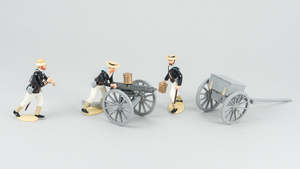 59 Naval Gatling Gun & CrewArabi Pasha and his army were attacked by Lord Wolseley’s Expeditionary Force at the Battle of Tel-el-Kebir. On the extreme left flank of the British front were the Indian Contingent with the 197 Naval Brigade with their six Gatlings. As the Brigade charged, with their cutlass-bayonets fixed the G...Visit Store 0 0
 -
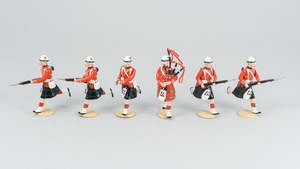 62 BlackwatchAt Tel-el-Kebir, in September 1882, the Egyptian army was assembled behind extensive defence works. Sir Garnet Wolseley, concerned at attacking in the heat of the day ordered a night time advance. The Black Watch formed on the right of the 2nd Division’s Highland Brigade. At 1:30 a.m. the order to...Visit Store 0 0
 -
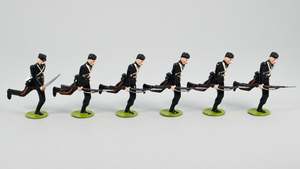 2 Waikato Militia, 1864Many of the regiments four thousand recruits were from Australia, where the regiment was raised in 1863. In October 1864 they were in action at Titi Hill and in April at Waihi.On 21 June at Pukehinahina and Te Ranga they became the first colonial troops to take part in a charge with British Regulars.Visit Store 0 0
 -
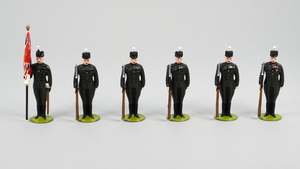 8 Eketahuna Mounted Rifles, 1907The Ekatahuna Mounted Rifles were accepted as a Volunteer Corps on 10 September 1900, but not before some men had already left to serve in the South African War.Dress uniforms were provided in 1904, and their colour was presented in 1907 by the Governor, Lord Plunket, on New Zealand’s first Dominion Day.Visit Store 0 0
 -
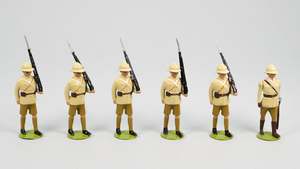 5 Maori Contingent, 1914In the first year of the war in 1914, two Maori companies were formed. This contingent left New Zealand for Egypt in February 1915, and from July 1915 took part in the Gallipoli Campaign.After this campaign the Contingent was split up, but after Maori protest at home the unit was reformed as a Pioneer Battalion and served in France.Visit Store 0 0
 -
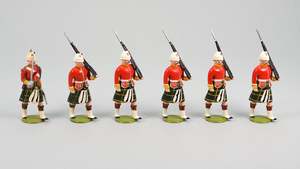 7 South Australian Scottish Infantry, 1903After a meeting in early 1900, “G" Company, 2nd Battalion (Reserve) Adelaide Rifles, was formed. Their first kilted parade was Queen Victoria’s memorial service at Flinders Street Presbyterian Church.In 1903 “G" Company became the South Australian Scottish Infantry. They last paraded in 1912. Several members of the unit later commanded Infantry Battalions in World War I.Visit Store 0 0
 -
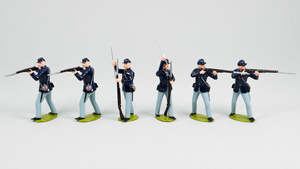 A6 Union InfantryIn 1861, at the outbreak of the Civil War, the regular Union Army had an existing set of Dress Regulations, prescribing for infantry both dress and fatigue uniforms.This set of figures depicts men uniformed and equipped for campaign with the fatigue cap, fatigue sack coat, cartridge box, percussion ...Visit Store 0 0
 -
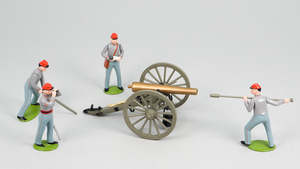 A2 Confederate ArtilleryAt the onset of the Civil War, the artillery of the Confederacy was dependent on what was taken from southern Federal arsenals, what was in the possession of the Southern Militia units and after early successes in battle on captured Union Artillery.Little ammunition had been made in the South for ma...Visit Store 0 0
 -
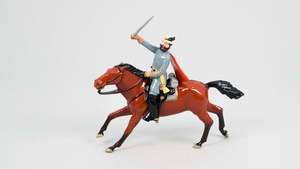 A23 Major General J. E. B. StuartMajor General J.E.B. (James Ewell Brown) Stuart was the Confederacy’s most celebrated cavalry commander, known for his boldness, mobility, and flair. Dressed in a plumed hat and often accompanied by banjo-playing troopers, he embodied the romantic image of the Southern cavalryman. Stuart excelled ...Visit Store 0 0
 -
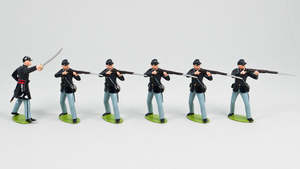 A5 Union InfantryIn 1861, at the outbreak of the Civil War, the regular Union Army had an existing set of Dress Regulations, prescribing for infantry both dress and fatigue uniforms.This set of figures depicts men uniformed and equipped for campaign with the fatigue cap, fatigue sack coat, cartridge box, percussion ...Visit Store 0 0
 -
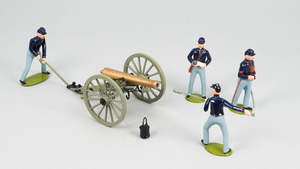 A1 Union ArtilleryThis smoothbore weapon was developed in France in the 1850’s and named for Emperor Napoleon III. Adopted by the United States Army in 1857 the Napoleon became termed the ‘workhorse" of Civil War Artillery, for its manoeuvrability and the range of ammunition that could be fired. Solid shot was fo...Visit Store 0 0
 -
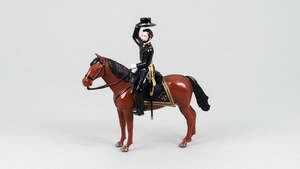 A3 General Ulysses S. GrantUlysses S Grant was a West Point graduate and served in the Mexican American War, returning to Civilian life in 1854. He joined the Union Army shortly after the start of the Civil War and became one of the Union’s most important generals. After early successes in the Western Theater—capturing Fo...Visit Store 0 0
 -
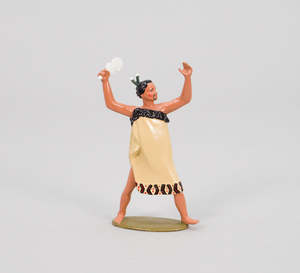 TM02 KotiateMan of rank wielding a whalebone club kotiate. In his hair is a huia bird feather, a symbol of prestige, and his face bears a tattoo moko, a process not begun until manhood. Suspended from his ear is a straight greenstone pendant. He wears a cloak with taniko design on one edge, often worn in combat to ward off spear thrusts.Visit Store 0 0
 -
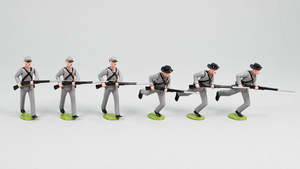 $240A10 Texas BrigadeThe 1st, 4th, and 5th Texas Infantry Regiments were formed at ‘Camp Texas’ near Richmond, Virginia in October 1861, from companies that had travelled from Texas. Under the command of Colonel John Bell Hood, they became known as Hood’s Texas Brigade.The Texas ‘Lone Star’ emblem was incorpor...Buy from Store 0 0
 -
 $300102 Polish Lancers, 1st EmpireThe Polish Light Horse of the Imperial Guard were raised in Poland in 1807 when Napoleon created the Grand Duchy of Warsaw.They were sent to Spain in 1808 where they were taught outpost duties by the famous General Lasalle. Their first proper action was at Somosierra Pass where one squadron charged ...Buy from Store 0 0
 -
 $120106 General Edouard Colbert, 1st EmpireUpon taking part in many of Napoleon's actions, Colbert gained a high reputation as a brave cavalry leader. Attached to the Imperial Guard in 1811 he commanded the 2nd Regiment de Chevau-Legers/Dutch Lancers. He is depicted in that uniform.Buy from Store 0 0
 -
 $300105 Dutch LancersSet 105 includes three mounted cavalry figures.The 2nd Regiment of Light Horse Lancers of the Guard (Dutch Lancers) were raised in 1810 from the hussars of the Dutch Royal Guard. From their inception until disbanding in 1815, their commander was Eduard Colbert, General of Division. The regiments fir...Buy from Store 0 0
 -
 $120134 Officer 5th Chevau-Légers Lancers, 1st EmpireUniformed and equipped as 3rd Lancers, except regimental facing colour on uniform and horse schabraque is in the 5th’s regimental colour of sky blue.In 1811 Napoleon converted six regiments of Dragoons into Lancers of the line. Serving with valour in the campaign of 1812 they were almost destroyed...Buy from Store 0 0
 -
 $145123 Polish Lancers Drum HorseThe drummer's head dress is surrounded by a fur turban. It is decorated with a panache of red and white feathers as is the horses head. The 17th Century horse harness was covered with brass scales with turquoise centres.Horse schabraque and drum banners are of crimson velvet with gold lace.Buy from Store 0 0
 -
 $30095 Chasseurs à ChevalSet 95 comprises a set of three Chasseurs à Cheval cavalry, an elite unit that served as personal guard to the Emperor.The imperial guard was a large and complex organisation including cavalry, infantry, artillery and marine regiments which were accorded a privileged status within the French Army. ...Buy from Store 0 0
 -
 $120132 Officer 3rd Chevau-Légers Lancers, 1st EmpireUniformed as for the men except his helmet turban is leopard skin. The horse schabraque is piped with the regimental pink, and gold lace, with a leopard skin covering both pommel and seat.At the Battle of Waterloo, the 3rd Chevau-Legers Lancers commanded by Colonel Martigue, and attached to the 1st ...Buy from Store 0 0
 -
 $300131 3rd Chevau-Légers Lancers, 1st EmpireThey wear a neo-Grecian helmet with fur turban and upon the crest a woollen crest. The tunic lapels, turn-backs, cuffs and collars were of the regimental pink. The saddle is covered by a white sheepskin edged in ‘wolves’ teeth’ material also in the regimental pink.At the Battle of Waterloo, th...Buy from Store 0 0
 -
 $300147 7th Hussars British Army, Waterloo 1815Between 1800 and 1807 the British army converted four regiments of Light Dragoons into Hussar regiments.These became the 7th, 10th, 15th and 18th Hussars of which the Prince of Wales became such an enthusiastic patron that he had made a complete officer's uniform and appropriate saddlery and harness...Buy from Store 0 0
 -
 $12089 Lord Cardigan 1854As commander of the Light Cavalry Brigade, Cardigan led the infamous "Charge of the Light Brigade" upon his warhorse Ronald. His pelisse worn closed has brown fur trim, gold braid and lace. From his waist belt, like his men, is suspended sword scabbard and undress sabretache.Just before midday at th...Buy from Store 0 0
×