
Blue Eye aka Evil Eye Anklet
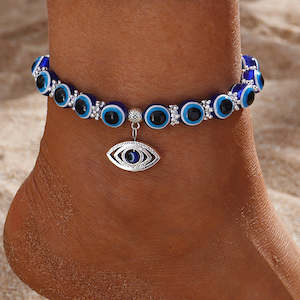
The blue eye most commonly known as the evil eye has a long and fascinating history that spans many cultures and centuries. Here's a brief overview: Origins and Meaning
- The evil eye is a symbol believed to protect against the "evil eye curse"—a malevolent glare thought to cause misfortune, injury, or bad luck.
- This belief dates back to at least the 6th century BCE, with roots in ancient Mesopotamia, Greece, and Rome.
- The concept also appears in Jewish, Islamic, Hindu, Buddhist, and Christian traditions, each with its own interpretations and protective practices. The Ornament Itself
- The most iconic form is the blue-and-white glass bead, often called a nazar in Turkish.
- These ornaments are typically circular, with concentric circles resembling an eye—usually dark blue, light blue, white, and black.
- They are worn as jewelry, hung in homes, cars, or businesses, and even incorporated into clothing and accessories. Cultural Spread
- Turkey is perhaps the most well-known modern center for evil eye ornaments, where they are deeply embedded in daily life.
- In Greece, it's called μάτι (mati), and similar talismans are used widely.
- The symbol has also spread across the Middle East, North Africa, South Asia, and more recently, into Western fashion and pop culture. Modern Usage
- Today, evil eye ornaments are both spiritual symbols and fashion statements.
- They are popular in jewelry design, home décor, and even digital emojis (🧿).
- While some wear them for protection, others simply appreciate their aesthetic or cultural significance.