
SERPENT: Serpent Viper 990 4wd 1/8 GP
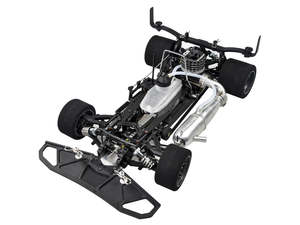
The ultra-narrow chassis is milled down to allow the lower radio plate as well as improved flex. keeps the improved flex characteristics. The central hole underneath the tank is narrower, as a consequence of the narrower chassis.
The central weight bridge is now mounted from underneath and allows for a quick change of the weight.
The weight itself is now fixed using a nylock nut. Bulletproof!
The front weight bridge is now also mounted from the bottom to allow easy access to the weight.
Also the front weight is now adjustable from the bottom.
There are 2 additional locations to put a small weight, just behind the servo-saver.
And in front of the engine.
The engine has been lowered 1mm for improved flex as well to lower the CG
The rear of the chassis has a slot. This will be explained later here. It has to do with adjustable flex. It also carries 2 steel countersunk screws that act as a counterpart of the down-stop screws. This helps to keep the down-stop more accurate and consistent
Talking about flex: we tested a lot and one of the improvements came from lowering the radio plate by 2.5mm. We also changed the shape of it.
The front of the car can be adjusted to more flex by removing the front stiffener bracket
The rear of the car is also adjustable regarding the flex. To regular rear end features the proven, one-piece rearplate
As an option it is also possible to use a softer rear end using a optional 2-piece rearplate
The radio-box is completely new. The “backbone" of it is a carbon plate and an aluminium frame.
The aluminium servo mounts are eccentric and can be mounted in 2 ways to adjust them to the brand of servos.
The receiver box is more spacious than the one used in our 988, still it is very compact. It provides enough space even for older type receivers plus the transponder
This new box is mounted to the radio plate in a flexible way in order to not influence the flex of the car.
The extending arm of the frame helps to keep the radio box in the desired position without influencing flex.
The rear end is completely new.
It features a new design to allow an re-active toe-change as well as avoid any binding at all!
By changing the position of the link the amount of toe-gain under compression can be adjusted. The position shown is the “neutral" position.
Since the upper link is replaced by a suspension arm, we also changed the upper pivot on the upright. It is now super easy to adjust the correct camber.
The height of the pivot ball is adjustable by changing the aluminium insert. There are 3 positions
The upright carries an aluminium insert where the ball bearings of the wheel axle sit. In that way we can achieve the perfect roundness even under load to achieve the least friction of the transmission possible.
In this way it is also really easy to remove the wheel axle/driveshaft for maintenance
The front steering-block features a similar construction.
The aluminium insert gives the same advantages as in the rear with improved drivetrain efficiency and improved ease of maintenance
But because this insert is eccentric, as is also possible to change the roll-centre as well las using a trailing or leading set-up.
Of course the steering-blocks are still left/right symmetrical and can be used with option1 as well as option2 levers.
The front upper suspension bracket now has an improved design that provides a better placement to avoid camber or caster irregularities by using bushings.
The new lighter 2-speed shaft is 10g (!) lighter and features a super-true mounting of the 18t pulley adapter.
7075 T6 Aluminium 5mm chassis plate
The 5mm alum