
Basalt rock (vesicular)
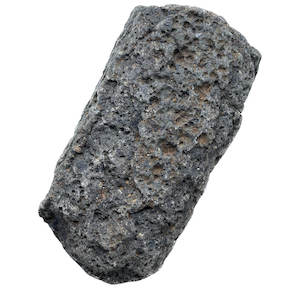
Vesicular basalt is a fine-grained, hard, dense rock with numerous rounded cavities. Basalt is the most common rock on the Earth, Moon and Mars and it has erupted from volcanoes scattered throughout New Zealand.
Igneous: Rock formed from lava flows (therefore technically a 'volcanic igneous' rock).
Source location: Canterbury.
Sizes: Choose from dropdown menu either Shelf specimen (300–800g), or Hand specimen (less than 300g)
Note: Images are examples of specimens only. Sizes and shapes will vary. More detail Structure
Basalt is a fine-grained igneous rock with a dense and homogeneous structure. It is typically composed of minerals such as pyroxene, plagioclase feldspar, and olivine. Type
Volcanic igneous. Physical Properties of basalt
- Colour: Typically dark grey or black in colour.
- Lustre: Dull to glassy lustre, depending on its texture and mineral composition.
- Hardness: A relatively hard rock, ranging from 5 to 6 on the Mohs scale.
- Density: Ranges from 2.8 to 3.0 grams per cubic centimetre.
- Fracture: Exhibits a conchoidal fracture, meaning it breaks with smooth, curved surfaces resembling the interior of a seashell. General Properties of basalt
- Fine-Grained Texture: Has a fine-grained texture due to its rapid cooling from lava or magma, resulting in small mineral crystals.
- Interlocking Structure: Its minerals form an interlocking structure, contributing to its strength and durability.
- Weather Resistance: Highly resistant to weathering, erosion, and chemical attack, making it suitable for outdoor applications.
- Heat Resistance: Has excellent heat resistance and can withstand high temperatures without significant deformation or damage.
- Low Porosity: Relatively low in porosity, making it less susceptible to water absorption and freeze-thaw damage. Uses of basalt in New Zealand and worldwide
- Construction: Widely used as a construction material, including for building facades, walls, and road construction.
- Paving: Its durability and resistance to weathering make it suitable for paving stones, footpaths, and driveways.
- Landscaping: Used in landscaping projects for retaining walls, decorative features, and pathways due to its natural beauty and durability.
- Aggregate: Crushed basalt is used as aggregate in concrete, asphalt, and road construction.
- Railway Ballast: Utilised as railway ballast, providing stability and drainage to railway tracks.
- Dimension Stone: Can be cut and polished into slabs for architectural purposes, including countertops, tiles, and monuments.
- Geological Studies: Studied by geologists to understand volcanic processes, lava flows, and the history of Earth's crust.
- Store:
- Science Resource Box
- Price:
- $11.95