
Slate rock
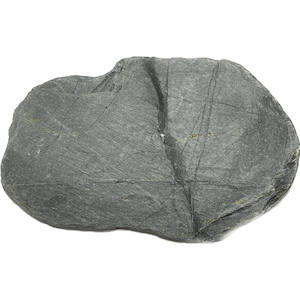
A fine-grained rock that splits into thin, flat sheets. It is frequently seen on the roofs of historic buildings because of its durability and resistance to moisture.
Metamorphic: Formed from the compression and metamorphism of shale or mudstone.
Source location: Westland and Marlborough.
Sizes: Choose from dropdown menu either Shelf specimen (300–800g), or Hand specimen (less than 300g)
Note: Images are examples of specimens only. Sizes and shapes will vary. More detail Structure
Slate is a fine-grained metamorphic rock formed from the compression and metamorphism of shale or mudstone. It typically exhibits a distinct foliation or layered structure, resulting in its ability to be split into thin, flat sheets.
Type
Metamorphic. Physical properties of slate
- Colour: Can have various colours, including grey, black, green, purple, or red, depending on the presence of different minerals.
- Lustre: It typically has a matte or dull lustre.
- Hardness: Low hardness of around 3 to 4 on the Mohs scale, making it easy to cut and shape.
- Density: Ranges from 2.6 to 2.8 grams per cubic centimetre.
- Cleavage: Exhibits excellent cleavage, allowing it to be split into thin, smooth sheets along its foliation planes. General properties of slate
- Foliation: Characterised by its well-developed foliation, with the rock splitting into thin, parallel sheets due to the alignment of minerals during metamorphism.
- Texture: A fine-grained texture, often feeling smooth and soft to the touch.
- Low Porosity: Relatively low in porosity, making it impermeable to water and resistant to staining and weathering.
- Durability: Highly durable and resistant to wear, making it suitable for various applications.
- Fire Resistance: Fire-resistant, making it a desirable material for fire surrounds and roofing.
- Insulation: Exhibits excellent thermal and sound insulation properties, providing energy-efficient benefits.
Uses of slate in New Zealand and worldwide
- Roofing: Commonly used as a roofing material due to its durability, impermeability, and aesthetic appeal.
- Flooring and Paving: Its smooth texture and durability make it suitable for flooring, pathways, and outdoor paving.
- Cladding: Used as a decorative cladding material for walls, facades, and interior surfaces.
- Writing Surfaces: Historically, slate was used as writing surfaces, and it is still used today for blackboards, chalkboards, and signage.
- Crafts and Artwork: Used for artistic purposes, including sculptures, carvings, and decorative objects.
- Billiard Tables: Its flatness, smoothness, and durability make it ideal for the playing surface of billiard tables.
- Memorial Stones: Used for memorial stones and gravestones due to its durability and ability to retain inscriptions.
- Store:
- Science Resource Box
- Price:
- $11.95