
Canon EOS R7 - Nauticam NA-R7 Housing - 17338
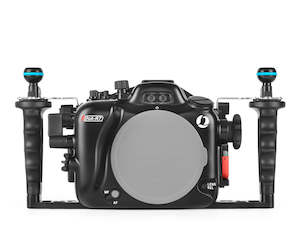
The Canon EOS R7 is the latest in Canon's APS-C mirrorless camera lineup which has gained unprecedented demand. It features the RF lens mount which has the same large 54mm diameter but the ability to have larger rear lens elements that are closer to the sensor gives increased corner and outer edge sharpness.
The R7 uses a 32.5MP CMOS sensor with in-body image stabilization which can reduce shake by up to 7 stops. The camera's Dual Pixel II autofocus system was carried over from the pro body EOS R3 and features 651 automatic AF points covering the entire sensor area. It is also capable of recording oversampled 4K 30p video using the full 7K area of the sensor, or subsampled UHD 4K up to 60p from the full sensor width.
The EOS R7 can also use the large EF-mount lens lineup via a simple EF to EOS R adaptor. The Nauticam NA-R7 housing only supports the the standard EF to EOS R adaptor and does not give access to the control ring or drop in filter adaptors.
Key Camera Specifications
- 32.5MP APS-C CMOS sensor with Dual Pixel AF
- Up to 30 fps shooting (e-shutter), 15 fps with mechanical
- In-body image stabilization, rated at up to 7 stops
- Oversampled UHD 4K up to 30p, line-skipped or cropped 4K/60p
- 10-bit video as 'PQ' true HDR footage or C-Log
- 2.36M dot OLED viewfinder
- 1.62M dot fully-articulating touchscreen
- Twin UHS-II SD card slot
- Environmental sealing The Nauticam NA-R7 Underwater Housing for the Canon EOS R7 Camera
The NA-R7 underwater housing follows suit with Nauticam's drive for innovation. Like the full frame Canon EOS R5, R5 C and R3, the NA-R7 present shooters with the ability to use both the available legacy EF lenses via an adapter in addition to their native RF optics. To support both the legacy and native lenses, Nauticam has designed a N100 to N120 adapter which integrates into the N120 Canon EF port system. Canon's EF to RF mount adapters can be affixed to the camera before insertion into the housing. When using the EOS R7 inside the housing with the adapter and a supported EF lens, the port and extension ring arrangement will be identical to the same setup on a Nauticam Canon N120 DSLR. As the RF-S lens lineup emerges, dedicated port and extension ring combinations will be listed on the new N100 RF-S Port Chart. Mission Control
Nauticam engineers are obsessed with getting the underwater image maker unfettered access to all the necessary controls, with as many within easy reach of the ergonomic rubberized handles. This Mission Control philosophy extends to the NA-R7 where a dual thumb lever is placed by the right front side accessing the M-Fn and Record buttons. On the rear right side is a thumb lever accessing AF-ON. Near the left handle is a thumb lever for "Playback."
Large knurled and rubberized control dials access the camera's "main" and "sub" command dials. The two-stage trigger allows for smooth focus and firing activation. Additional buttons for "Menu", "Focus Point Selection" and others are also easily reached from the handles. WWL-1B, CMC-1, AND CMC-2
Three in-house Nauticam optical designs, designed by founder and Managing Director Edward Lai, are the perfect lenses to complete an R7 underwater system. The magic of the wet lenses is their tremendous versatility, paired with outstanding in-water performance. Both macro and super wide angle optics are available to the underwater photographer on the same dive. These lenses are completely engineered for use in water, providing the highest image quality available today in a wet mount optic.
WWL-1B is a wide angle conversion lens, compatible with the Canon RF-S 18-45mm f/4.5-6.3 IS STM lens. This combination provides an 130 degree diagonal field of view with full through down to a 60 degree diagonal field of view! The WWL-1B will provide you with class leading center sharpness, corner sharpness, and contrast resulting in the clearest wide angle images possible underwater.
CMC-1 & CMC-2 provide the best macro performance available, with two different magnification strengths, suitable for a wide variety of macro subjects. With the Canon RF-S 18-45mm f/4.5-6.3 IS STM lens, CMC-1 is capable of 0.8X magnification, while CMC-2 achieves 0.6X magnification. CMC-2 is less strong, making it easier to use with more accurate autofocus. CMC-1 is best suited for the smaller macro subjects. Macro enthusiasts will surely want both! Flash Triggering
Flash triggering is achieved via one of two optional Flash Triggers, a manual LED trigger (PN 26305) or a TTL Flash Trigger for Canon II S (PN 26323) that use the built-in fiber optic bulkheads with optional fiber-optic cables to trigger supported strobes. For controlling strobes that do not supp